Mountain Law 2025: everything you need to know about mandatory snow tires before hitting the road
Implemented in 2021 in France, the Mountain Law II aims to ensure the safety of road users during the winter period. What does it consist of? Are you affected? What are the mandatory equipment requirements? What are the risks for motorists in case of non-compliance with this road law? We answer all your questions so that you can calmly prepare your winter sports vacation, in compliance with the regulations in force.
Mountain Law: what is it?
To summarize it concisely, the Mountain Law is a road safety regulation that requires specific equipment for driving in mountain ranges in winter.
The idea behind this law is to avoid accidents, even minor ones, on snowy or icy roads. This primarily helps toimprove motorist safety, but also to smooth traffic flow, by preventing vehicles from getting stuck in the middle of the road and by limiting interventions by emergency services (firefighters, police, gendarmerie, etc.).
Are you affected by the Mountain Law for your stay?
The Mountain Law does not concern all of France and is limited to the winter period. Here is all the useful information to know to find out if you will be subject to the obligations of the Mountain Law when you leave for your vacation.
Vehicles subject to the regulation
As soon as your vehicle has at least 4 wheels, you are obliged to equip it with the devices provided for by the decree of June 23, 2021, which governs the Mountain Law.
Therefore, the vehicles concerned are cars and other passenger vehicles, utility vehicles, motorhomes, buses and heavy goods vehicles.
The period during which the Mountain Law applies
The Mountain Law is in effect every winter from 1er November until 31 March. Outside this period, snow tires, chains, socks, and other equipment are not mandatory.
Nevertheless, it is highly recommended to always have the appropriate devices in your trunk, even if you go skiing in early autumn or spring. Indeed, snowfall, black ice, and very cold temperatures remain common at high altitudes, and good equipment for your wheels could save you from unpleasant surprises.
Areas where the Mountain Law 2025 applies
All mountain ranges are potentially affected by the Mountain Law: Alpes, Pyrénées, Jura, Massif central and Vosges. Nevertheless, the final decision rests with the prefect, in the 34 departments that make up these ranges (Savoie, Haute-Savoie, Cantal, Hautes-Alpes, Isère, Puy-de-Dôme, etc.).
Indeed, after discussion between the prefect and local elected officials, the list of communes where the Mountain Law applies is established annually for each department. This list can be consulted online and may change from one year to the next: remember to check it before your departure, by looking for both the resort where you will spend your vacation and also checking the communes your route passes through.
On-site, signs will precisely indicate the mountain areas concerned (signs at the entrance and exit of the zone), where you must have the appropriate winter equipment.
How to equip yourself to comply with the Mountain Law obligations?
4-season tires, snow tires, chains, socks: here's everything you need to know to equip your vehicle in compliance with the Mountain Law 2025.
Winter tires or snow tires
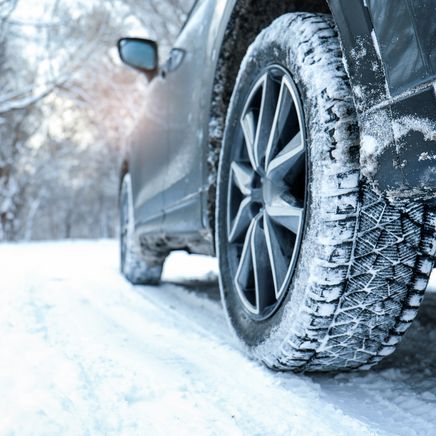
Since the 2024-2025 season, regulations have become stricter regarding the use of snow tires in mountain ranges in winter. Now, to be compliant, your winter tires must include the 3PMSF (Three Peak Mountain Snow Flake) marking. Furthermore, it is necessary that these tires equip all 4 of your wheels, and not just the drive wheels.
In the absence of this marking on your tires, even if your winter tires are high-performance or if you have 4-season tires, you will need to have removable anti-slip devices in your trunk to be able to equip your vehicle in the areas concerned.
Removable anti-slip devices
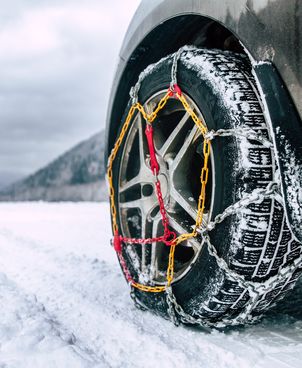
In the absence of winter tires with 3PMSF marking, you have a choice between 2 types of devices, which must equip at least 2 drive wheels of the vehicle:
metal snow chains, offering the best performance for driving on snowy terrain or in case of black ice;
pair of textile socks designed for snow, easier to fit, but rather recommended for occasional use.
Of course, when purchasing your chains or socks, you must ensure they are perfectly adapted to the tire size of your vehicle.
Dangers and penalties if you do not comply with the Mountain Law
These mandatory pieces of equipment may seem restrictive, but they are essential to prevent skidding and blockages on mountain roads and in departments where winter conditions are harsher than elsewhere. They are a guarantee of your safety and that of other road users.
Officially, in case of non-compliance with the Mountain Law, you risk a flat-rate fine of 135 euros. In many cases, however, education is favored over repression, and penalties of this type remain rare.
On the other hand, in the absence of adequate devices, drivers may be refused access to a regulated zone. Furthermore, in the event of an accident, the insurance may refuse coverage and compensation if the vehicle is not in compliance with the Mountain Law.