How to choose your snowboard?
Do you feel like surfing and want to know how to choose your board for your next mountain surfing session?
You've come to the right place! The choice of equipment will depend on two main elements:
1.Your level : beginner, intermediate, advanced, expert
2. The type of use you intend to make of it (piste, freeride, freestyle). The characteristics of the board will also influence its behavior.
Without further ado, follow the guide and discover what differentiates the types of boards!
In summary
Choosing a snowboard depends on your skill level (beginner → soft flex, intermediate → medium flex, advanced/expert → stiff flex) and intended use: all-mountain for versatile on-piste/off-piste (10-20 cm below your height), freestyle with a soft and light board (20-25 cm below your height), freeride with a stiff, long, and wide model with a pronounced rocker for powder, or carving/splitboard for speed and touring. Other key criteria: width according to foot size (less than 25 cm for small feet, more than 26 cm for sizes above 45), camber (traditional = power/precision, rocker = powder float), and shape (directional, true twin, or hybrid) depending on the desired use. At Sport 2000, online snowboard and boot rental gives you access to in-store advice, ideal for testing before buying.
How to choose your snowboard based on your level?
First step: first determine your level to know how to choose your snowboard.
Beginner level:
You manage to descend small well-groomed green or blue slopes.
You still use skidding a lot to turn.
You are able to perform small jumps on flat surfaces
You are in the phase oflearning switch.
Sport 2000 Tip : You therefore need a snowboard with a flexible flex (stiffness index) soft to start .
Intermediate profile:
You manage to descend well-groomed slopes ranging from blue to red
You turn without using skidding.
You are able to perform jumps on small bumps
You perfectly master the switch.
Sport 2000 Tip: If you are an experienced snowboarder who knows how to perform some tricks and switch without problems, you need a board with a medium flex.
Confirmed or expert level:
If you have an excellent level, that you perfectly master narrow or extremely steep slopes, jumps (including boardslides) and your speed, you need a board with a stiff flex for good grip, whatever the snow quality or your speed.
Which snowboard for which use?
While snowboard pros can adapt to all types of snow, this is not the case for everyone, so it's important to choose your board based on the terrain you want to conquer. As with alpine skiing and other winter sports, the type of practice, your riding style, and the areas where you will ride determine the best choice.
How to choose your snowboard based on the terrain? The smaller the model, the better its maneuverability (jumps, changes of direction). Conversely, a long board promotes speed. Light people have every interest in opting for a rather short model.
For on-piste use
For mixed use, on-piste and off-piste, use a model all-terrain freestyle (also called all-mountain). It will give you complete satisfaction, whatever the snow conditions, both on groomed slopes and in powder snow thanks to adequate floatation. You can also perform some jumps in a snowpark. The board should have a length of 10 to 20 cm less than your height.
For freestyle use
Is your main objective freestyle use? Avoid overly stiff models which can break when overcoming obstacles (especially rails...) or whose weight can be a handicap for performing jumps. Take a model 20 to 25 cm less than your height.
For freeride use
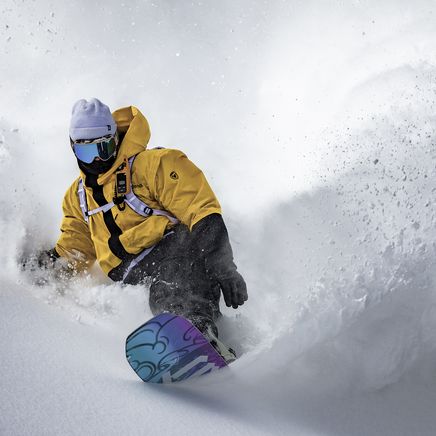
Freeride boards are quite stiff, longer than all-mountain boards, to provide more stability. Quite wide, they also have a rather pronounced rocker, to obtain better floatation on snow.
They are now also designed for groomed slopes.
How to choose a 100% powder snowboard (intended for riding in powder snow)? Choose an appropriate model: short, wide and sometimes characterized by a swallow tail at the back. Don't go on a groomed slope with it, it's not designed for that!
For carving
Finally, carving snowboards are designed for high speed on flat surfaces, while the splitboard separates into 2 parts if necessary to form... a pair of skis.
Don't forget to choose a board wide enough so that your boots (shoes) don't catch the snow, without falling into the opposite trend, at the risk of losing maneuverability and responsiveness.
What are the other characteristics for choosing a snowboard?
Once you have a better idea of the snowboard style you want to go for, other elements come into play. It is particularly useful to ask yourself how to choose a snowboard based on its shoe size. For small feet, a model with a width of less than 25 cm will be suitable. Conversely, for large shoe sizes (size 45 or more), a model with a width greater than 26 cm is required.
And if you want to go further to find the perfect board for you among the multitude of available snowboards, we have some additional technical tips for you.
Also consider the type of camber:
A model with a traditional camber (curvature of the snowboard under your feet) pronounced favors power, precision, grip and speed.
An inverted camber (flat snowboard) and a rocker (raised nose and tail) will be more suitable for deep powder and ensure better stability.
Note that some models combine these two characteristics.
Next, how to choose a snowboard based on its shape? There are 3 different shapes:
Directional shape : longer at the front than at the back. These models are versatile, as they provide both speed, ease in curves and can occasionally be used for freeride.
True twin : same length at the front as at the back, models suitable for freeride and switch.
Directional Twin shape, a compromise of the 2 previous categories.
Also look at the edges of snowboards. Like on a ski, the edges refer to the metal part located on the sides of the base, on each side. Short edges will facilitate turns, long edges will promote stability.
Finally, ask yourself how to choose a snowboard based on the type of turns you want to perform. It all depends on what you are looking for. A short radius favors fast and tight turns. A long radius favors large curves.
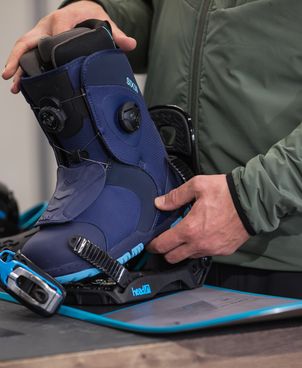
N.B. Essential accessories, remember to choose appropriate bindings and boots for both the intended use of the snowboard and your body type. By making your online snowboard and boot rental with Sport 2000, you will benefit from the advice of the in-store team to be sure to make the best choice. Depending on the store, the offer may include children's and adult snowboards, models for beginners, others for riding experts, still others specific to freestyle or freeride, etc. Equipment rental is also a very interesting solution to test a snowboard before eventually purchasing it, if you regularly spend your winter holidays in the mountains.