How to choose your alpine skis?
Also called piste skis, alpine skis are the ones most often found, as they are the models best suited for skiing on the groomed slopes of resorts.
Do you want to buy or rent a pair for this winter? Here are Sport 2000's tips for skiers hitting a slope for the first time, as well as for the most experienced skiers looking for an all-mountain ski.
In summary
Choosing your alpine skis depends mainly on your level, size, and style of practice. Beginner skiers will prefer short, flexible, and forgiving skis, while experienced and expert skiers will opt for longer, higher-performance models. Renting also allows you to test the latest technologies before a potential purchase.
Choosing your alpine ski model based on your level
The first criterion to take into account when wanting to know how to choose your alpine skis well is the skier's level. Indeed, a beginner skier will be more comfortable on skis with good stability, which will help them learn to move and manage their balance. On the contrary, an experienced skier will prefer a more responsive model that reacts to every movement. But then, how do you know what level you belong to?
Beginner level: you are learning to ski at low speed on blue or green slopes, and you alternate between skidding and snowplowing. You need a manageable and flexible ski.
Intermediate level: you feel comfortable on the slopes, including the red slopes, and you ski with your skis perfectly parallel, including in turns. You can opt for a progressive ski.
Confirmed level: you ski equally well on blue, green, red or black slopes with confidence, but you still have room for improvement. Choose a stiffer ski, offering good control at high speed.
Expert level: you have perfect mastery of skiing on groomed and off-piste trails, you are able to handle all situations and know every type of terrain. Turn to a rigid and reactive ski, equipped with high-end materials and technologies to maximize enjoyment and performance.
To know how to choose your alpine skis well according to your level, it is advisable to start from the principle that the better a skier is, the more able they are to handle long skis, which offer more float, although they are slightly heavier and more delicate to handle. Thus, a beginner skier will generally use skis 10 to 15 cm shorter than an experienced skier.
Don't forget that to choose your ski, you must indeed take your height into account: the length of the ski should be approximately 10 cm shorter than your height if you are a beginner, to go up to a length of 5 to 10 cm longer than your height if you are an expert.
Discover here all our other tips for making the right choices when renting or buying ski boots, ski poles, etc.
When to use mini skis, or short skis?
The short skis (also called mini skis or snowblades) are intriguing and, if they seem complex, they are actually quite easy to use once you reach an intermediate level. Knowing how to choose your piste skis from a range of mini skis allows you to discover the joys of skiing in a more playful way on gently sloping groomed runs.
Be careful, however, their small size makes them more difficult to control, so they are not intended for people who have never skied or who are just beginning to master the use of alpine skis, as they offer less stability. Similarly, they are not suitable for very steep slopes, as they require maintaining a moderate speed.
Rental or purchase: how to decide?
Do you ski every year and hesitate to buy your own pair of skis? Your question is legitimate and you might be tempted to buy your own equipment. However, it is not always the ideal solution.
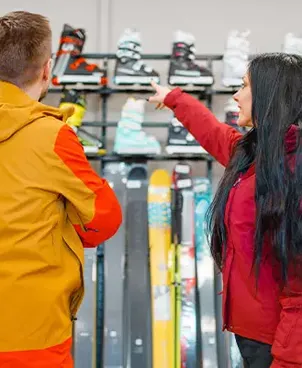
Indeed, ski manufacturers renew their technologies every year and buying your own equipment often means having equipment that quickly becomes obsolete. By renting your skis every year in our Sport 2000 stores, you ensure that you always have recent equipment to practice your best slide. It is also an opportunity to test skis with different characteristics to find the one that suits you best: more or less important radius, classic camber or inverted rocker camber, waist width, etc. If you are a bit lost among these technical terms, do not hesitate to discover our lexicon to understand what the tip, rocker, all-mountain ski, waist, tail, etc. are.
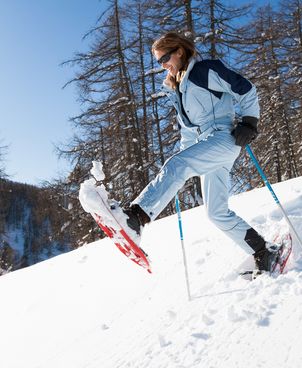
Furthermore, online rental gives you access to a wide choice of equipment, with a range that is not limited to alpine skis dedicated to the piste: freestyle skis for performing tricks in snowparks, freeride skis for evolving in powder snow, ski touring pack with boots, snowshoes for hiking, etc. Our stores can thus offer you the ideal type of ski according to your practice, snow conditions, and desires!


FAQ
Frequently asked questions about how to choose your alpine skis
-
How to choose the size of your alpine skis?
The length of your skis mainly depends on your height, but also on your skill level and your skiing style. A beginner skier will prefer shorter skis, generally 10 to 15 cm below their height, to gain maneuverability and learn turns more easily. Conversely, an experienced or expert skier can choose skis of the same size as themselves, or even slightly longer, to benefit from greater stability and precision at high speeds. In case of hesitation, our Sport 2000 teams can guide you towards the most suitable length.
-
Which ski to choose when starting?
To learn in the best conditions, choose a ski that is light, flexible and forgiving. This type of equipment facilitates the first turns, improves stability, and limits the effort needed to control trajectories. Skis for beginners are designed to offer maximum comfort and confidence on green and blue slopes, allowing for serene progress from the first descents.
-
What is the difference between a beginner ski and an advanced ski?
A beginner ski is designed to be easy to handle. More flexible and manageable, it is more forgiving of errors and facilitates learning. Conversely, a ski intended for an experienced skier is generally stiffer, more precise, and more reactive. It offers better grip on hard snow, more stability at high speeds, and allows full exploitation of one's technique on all types of slopes.
-
Are mini-skis suitable for beginners?
Contrary to popular belief, mini-skis are not the most suitable for learning to ski. Their small size makes them very maneuverable, but also less stable, which requires better balance and good control of support. They are more suitable for intermediate or advanced skiers who wish to discover a more playful glide on gently sloping runs.
-
Is it better to rent or buy your skis?
It all depends on how often you ski. If you only ski a few days or a few weeks a year, renting is often the most advantageous solution. It allows you to enjoy recent, well-maintained equipment adapted to snow conditions each season, without having to transport or maintain your skis. Buying can be interesting for very regular skiers, but it involves a more significant investment and does not allow you to benefit from the latest technological developments each season.
-
Can I change skis during my stay?
Yes, in most cases, it is possible to request a change of equipment during your stay, subject to store availability. If your level changes, if snow conditions change, or if you want to try another type of skis, the Sport 2000 teams can advise you and offer you equipment better suited to your practice, so that you can fully enjoy your mountain stay.