How to choose your ski boots well?
Essential for being able to ski all day without pain, comfortably and without risking a fall, choosing your ski boots well is no small feat, especially when you are a beginner skier. Whether you want to buy a pair of boots or rent one from one of the Sport 2000 stores, here are some professional tips for choosing your ski boots. And don't forget to also consult our guide to know how to choose your ski equipment , as well as our tips for all your other sliding equipment and accessories.
In summary
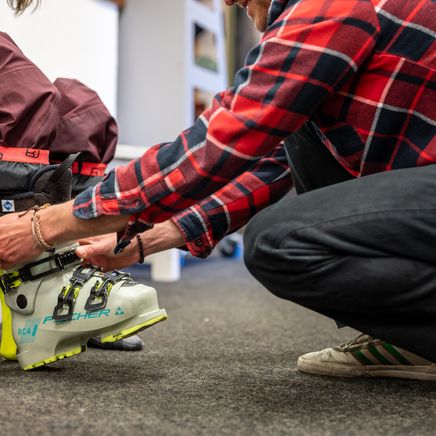
Choosing ski boots relies on 3 criteria: size (measure the exact length of the foot, not the usual shoe size, keeping the larger measurement between the two feet), flex (stiffness index, from 60-90 for beginners to 130-150 for pro skiers, with lower indices for women), and discipline (stiff boots for alpine skiing, flexible for freestyle, versatile for freeride, specific for cross-country skiing). For optimal comfort, boot-fitting (available in some Sport 2000 stores) allows for complete customization: thermoforming of liners, adjustment of tightening, and custom insoles.
Choosing the right shoe size
To choose your ski boots well, it is necessary to consider the size, without relying on your usual shoe size. Indeed, unlike the city shoes you wear every day, ski boots are not chosen based on your shoe size, but rather in relation to the exact size of your foot. A factor that many beginner skiers do not take into account, thus ending up with boots that are too large and do not support their ankle enough.
So, how to accurately measure the length of your foot to buy or reserve your ski boots online? It's very simple: the ideal is to take an A4 sheet of paper and place it against a wall. Then place your foot on the sheet, making sure your heel is firmly against the wall, then make a pencil mark at the end of your toes by performing a slight flexion, to find yourself in a position similar to the one you adopt when skiing.
Once that's done, you can do the same with the second foot, then measure the space between the edge of the sheet and the pencil mark. To choose your ski boots, it's best to refer to the largest measurement of the two: this will prevent one foot from being too tight in your boots while the other is comfortable. However, if you find yourself between two sizes, choose the lowest, because the liner may pack down when you wear your boots.
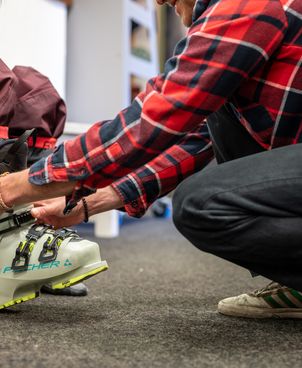
Good to know: most of the time, rental boots are 100 mm wide, as they suit most skiers. Nevertheless, choosing your ski boots well is important, so do not hesitate to ask for advice in-store if you have feet wider or narrower than average. Also, take advantage of the advice when picking up your equipment to properly adjust the tightness of each boot's buckles.
The flex: an essential criterion when choosing boots

To choose your ski boots well, it is necessary to look at the boot flex. Flex represents thestiffness index of the boot; thus, a boot with a flex of 120 or 130 will be much stiffer than a boot with a flex of 60 or 70. But then, how do you choose your ski boots based on their flex?
It's very simple: always assume that the softer the boot, the more suitable it will be for a beginner level. Indeed, when you start skiing, it is ideal to opt for boots with a flex rating between 60 and 90 for men, and 60 and 70 for women. Professional skiers, on the other hand, will tend to choose very stiff boots with a flex rating ranging between 130 and 150.
Do you ski every year for a few days during your holidays? In that case, the ideal is to consider buying or renting ski boots with a flex between 90 and 110 (men's boots) or between 70 and 90 (women's boots) : they will be comfortable and stiff enough to support your ankle during descents on steeper slopes and with more tight turns, such as red or black runs. It's a good compromise for precision and comfort on the piste.
Boot type according to discipline
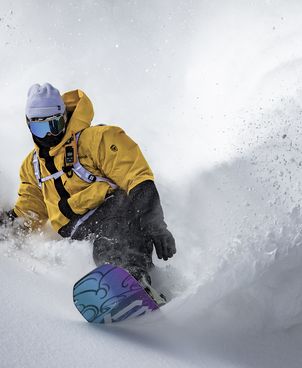
As with choosing your pair of skis, the sport practiced influences the choice of boot type. Indeed, the requirements are not the same if you do alpine skiing on piste, freeride (off-piste), freestyle, ski touring, etc. Alpine ski boots are among the stiffest, to ensure control and precision. Freestyle boots are softer, more flexible at the ankles, to offer more freedom of movement. As for freeride boots, they must be versatile, to be able to ski on all types of terrain and snow while always adopting the appropriate position.
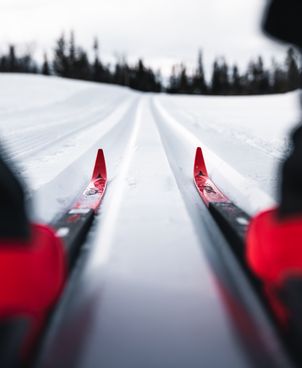
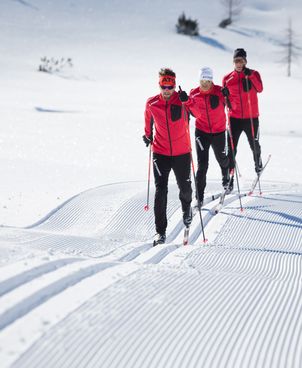
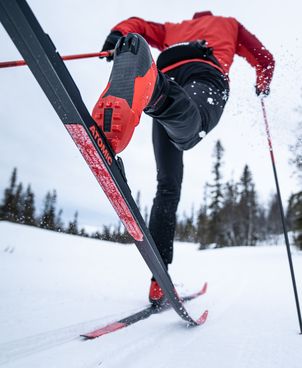
As for cross-country skiing, it is practiced with still different boots. That's why, when you rent your equipment online with Sport 2000 for classic or skating cross-country skiing, a complete pack skis + boots + poles is offered to you.
We have dedicated a complete guide to learning how to choose your cross-country ski boots well.
Boot-fitting: the solution for adapted liners and boots
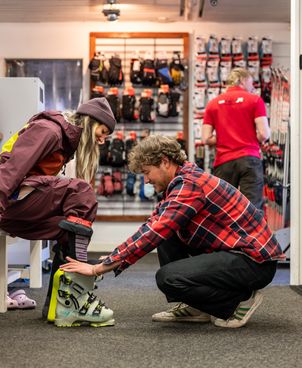
Are you a regular skier with a good level, and are you looking for the best compromise between comfort, precision, and support? Instead of getting lost in the labyrinth of ski boot brands and models, why not take advantage of the boot-fitting service offered by some of our Sport 2000 ski shops?
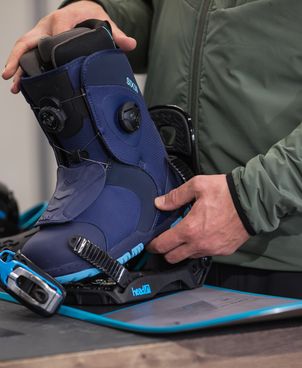
After a precise analysis of your foot morphology, an expert can guide you towards the right type of boot (size, stiffness, etc.), but above all, customize the different elements: thermoforming of liners, adjustment of tightening elements, structural modifications to the shell, manufacturing of custom insoles, etc. While the price will be higher than for a standard boot, you will undoubtedly appreciate the comfort and performance provided by this custom-made equipment.