How to choose your ski equipment without making a mistake?
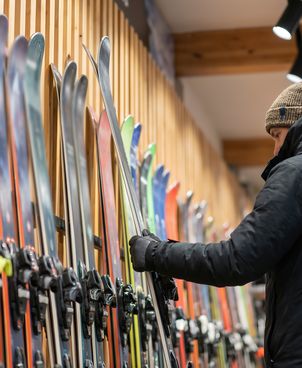
Going on a mountain holiday in winter is often an unforgettable moment. However, to live the most pleasant experience possible, choosing your equipment is extremely important. Be realistic about your ski level (first time skiing, beginner, good technical level, etc.), in order to get the most suitable equipment possible: ski boots, bindings, skis, poles, here are our expert tips for making the right choice when buying or renting equipment!
Book my equipment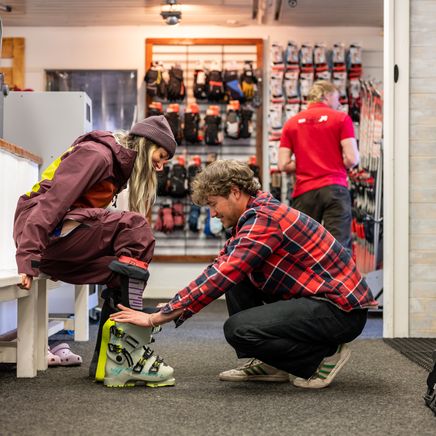
In summary
To choose your ski equipment well, it is essential to consider your level, your body type, and your practice. Boots, skis, bindings, and poles each play a role in comfort, safety, and performance. This Sport 2000 guide helps you select the most suitable equipment, whether you want to buy or rent your gear.
How to choose your ski equipment: good boots first and foremost
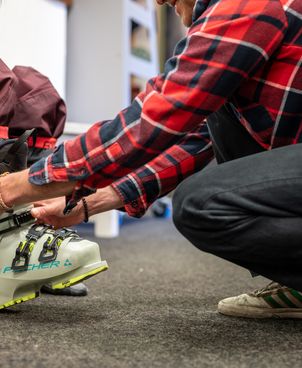
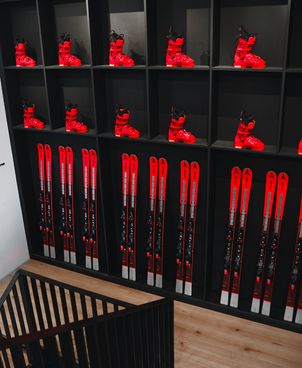
The ski boot is essential in a skier's gear. It allows you to attach to your ski binding, but most importantly, it greatly influences your skiing style, as well as your degree of precision. Therefore, knowing how to choose your ski equipment first means knowing how to choose your ski boots : this will prevent you from being uncomfortable on your skis once you're going at high speed and in turns.
Among the most important elements, you must therefore know the flex (the stiffness index) of your boot. This flex will partly determine the degree of foot and shin support. You must also be able to touch the tip of the boot when you stand up. Conversely, an oversized boot will cause rubbing, a painful shin, blisters, or even cramps. Also remember to try on your boots with the socks you will use on the slopes.
Finally, knowing how to choose your ski equipment also involves inquiring about the temperature variations : does your ski boot have a flex that allows you to ski in very cold weather and/or during spring temperatures (if, for example, you ski on the glaciers of the resorts of Tignes or ofAlpe d'Huez)? Is it equipped with a ventilation grill, etc.?
Choose ski bindings that are not too stiff
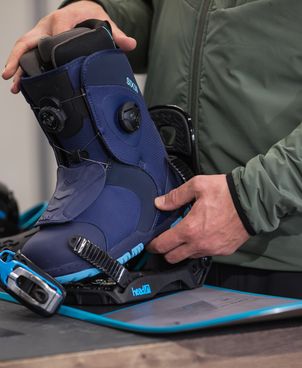
The alpine ski bindings are the link between your boots and your skis. There are bindings specially designed for freeride skis (off-piste skiing, mainly on powder snow).
Binding adjustment is governed by an international standard, allowing skiers to know how to choose their ski equipment: ISO 11088, in order to harmoniously adjust bindings, boots, and skis together.
Thebinding stiffness index is essential. Because you need a boot that is sufficiently held by the binding, while also allowing the binding to release in the event of a fall and thus prevent injuries (and even prevent the skis from sliding down the slope thanks to the "ski stopper" system). Just like the helmet and adherence to ski slope rules, the binding is indeed a safety element.
Thus, there is an adequate stiffness index depending on the ski model recommended (indicated by manufacturers), but also depending on your body type, your physical condition and your skiing level, essential factors for determining how to choose your ski equipment. An average stiffness ranges between 6 and 14. Do not adjust the stiffness of your bindings beyond 16, unless you are an excellent, very sharp skier.
And if you have any doubt, don't forget that when renting equipment with Sport 2000, the team takes care of the adjustments before you hit the slopes.
Choose ski types adapted to your level and intended practice
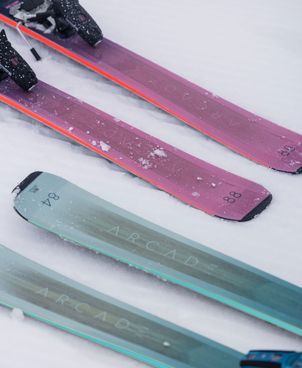
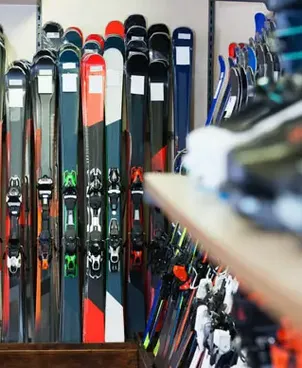
There are many ski models, with different characteristics, depending on the use you intend to make of them. Thus, all-mountain skis (all-terrain) will be suitable for both on-piste and off-piste. Freeride skis, which are wider, will be suitable for off-piste and a pair of freestyle skis (very light) for performing tricks.
Do the exploits of professional skiers in the giant slalom in Val d'Isère inspire you? If high-end racing (or carving) skis are designed for competition, they are exclusively for experienced skiers who know exactly how to choose their ski equipment. These are very stiff, longer skis, favoring extreme speed peaks, rapid edge changes, and significant angle turns. If you are a beginner, opt for a pair of classic alpine skis, tolerant and maneuverable.
Choose a ski that is your height or a maximum of 10 cm taller (15 cm if you have an excellent level and want racing skis).
Also be sure to check the robustness of the materials used in the manufacture of your skis.
Ski poles adapted to the terrain
There are special charts to select the correct size of ski poles according to your height and gender. Moreover, such charts also exist for skis, bindings, and boots, and quickly explain how to choose the appropriate equipment.
For freeride, take a pair of longer poles, with large baskets, so you don't sink into deep snow.
For freestyle, a beginner skier can settle for alpine ski poles, but an experienced skier or one looking to progress generally prefers shorter and lighter models, as this proves more practical for tricks.
Ski pole straps can also be detachable. Some models also feature protections, particularly suited for competitions, to "box" the gates in turns without getting hurt.
Need more tips for your next mountain weekend or upcoming ski holiday week? Our guide advises you on the choice of a snowboard, the choice of a ski helmet for your safety, the criteria for finding the right snowshoes for winter hiking, the clothes to pack in your holiday suitcase, etc.

FAQ
Frequently asked questions about how to choose your ski equipment without making a mistake
-
How to choose your ski equipment?
To choose your ski equipment, consider your level, size, body type, and practice. Boots, skis, bindings, and poles must work together to offer you comfort, safety, and enjoyment on the slopes.
-
How to choose your ski boots?
Boots should offer good support without causing pain. The flex must be adapted to your level: softer for beginners, stiffer for advanced skiers. They should be tried on with your ski socks to ensure an optimal fit.
-
How are ski bindings adjusted?
Bindings are adjusted according to several criteria: your weight, your height, your age, your skiing level, and the sole length of your boots. A compliant adjustment ensures good support while allowing the bindings to release in case of a fall.
-
Which skis to choose depending on your practice?
The choice depends mainly on the terrain you ski on. Alpine skis are ideal for groomed slopes, all-mountain skis offer more versatility, while freeride, freestyle, or touring skis cater to more specific practices.
-
How to choose the right size ski poles?
The size of the poles depends on your height and your practice. For alpine skiing, they should allow you to form an angle close to 90° at the elbow when the tip is on the ground. Models intended for freeride or freestyle have specific characteristics adapted to each discipline.
-
Is it better to rent or buy your ski equipment?
For occasional practice, renting remains the simplest solution. It allows you to benefit from recent equipment, maintained and adjusted by professionals, while having the possibility of testing different models according to your desires and snow conditions.