What ski size to choose?
To properly choose your skis, several technical criteria come into play, and one of the most important is undoubtedly the ski size. Each model is indeed available in several lengths, to meet the requirements of the type of discipline, as well as the level and body type of each person. Need advice on finding the ski size that will suit you? Follow the guide and never make a mistake again when it comes to choosing your skis, whatever practice you enjoy during your winter sports holidays!
In summary
What ski size should you choose to fully enjoy your days on the slopes? The right length does not only depend on your height, but also on your level, your body type, and your practice. Discover the benchmarks for choosing the right ski size for piste, freeride, freestyle, touring, or cross-country skiing, as well as advice for children's skis. With the expertise of Sport 2000, easily find the equipment suited to your needs. Read on to make the right choice.
Sport 2000's personalized advice for choosing your skis
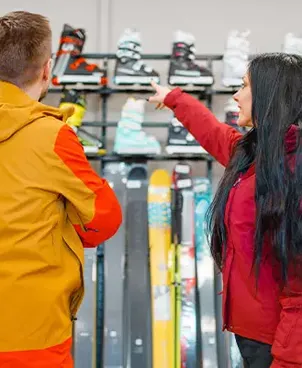
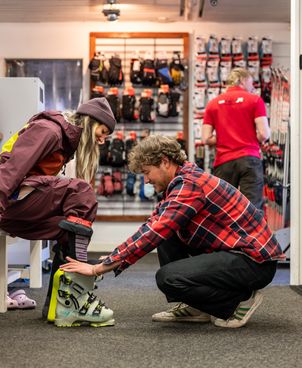
Whether you opt for online ski rental or in-store ski purchase, you will always be accompanied by Sport 2000 experts to choose the size of your alpine skis and find the model that meets your needs.
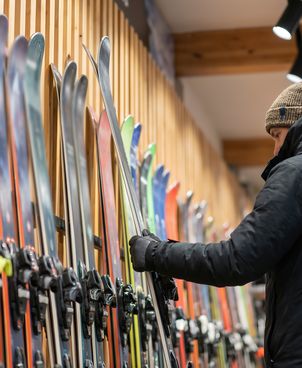
Personalized recommendations can be provided to you based on your skiing level, your expectations (on-piste, off-piste, touring ski, etc.), the snow conditions, your height and your weight. The advisor who welcomes you will always ensure to offer you an adapted ski size, and will place the pair next to you to check that it is not too short or too long.
You will also benefit from advice on the technical characteristics of the ski (rocker, parabolic ski, camber, etc.) and on the latest technologies, to maximize your performance.
What size downhill skis to choose?
Regarding alpine skiing, it is primarily the level that determines which ski length and waist width is most suitable, for both men and women.
On-piste skiing level | Length | Waist width |
Beginner | Short skis to facilitate turns: 10 to 15 cm shorter than the skier's height | 75 to 85 mm |
Intermediate | Skis 5 to 10 cm shorter than the skier's height, for better stability | 70 to 80 mm |
Advanced or expert | Skis at hip height, or even slightly longer (5 cm more) | 70 to 80 mm, or even up to 60 mm for maximum speed and for racing and slalom |
What size for freeride skis?
Due to its use mainly in fresh powder and ungroomed snow, the freeride ski does not have the same dimensions as an alpine ski: it is longer and wider. It also has the particularity of having a tip rocker to facilitate maneuverability in deep snow.
To choose the right freeride ski size, you should opt for a model 5 cm shorter to 10 cm longer than your height. As for the waist, it should be between 90 and 120 mm. The same length can be chosen for all-mountain skis, but prefer a slightly narrower waist for more versatility. The all-mountain ski is indeed designed to allow you to ski on groomed slopes as well as in powder and on all types of snow.
What is the right length for freestyle skis?
Choosing the right freestyle skis is also important for great freedom and maneuverability when performing tricks. Generally, their size should be 5 to 10 cm shorter than your height, but it also depends on your practice. In a snowpark, it is especially preferable to have a ski slightly smaller than you, or even your height.
The waist should also be a little wider than that of a classic alpine ski, i.e., between 85 and 100 mm for stability.
Other characteristics of freestyle skis are their twin-tip which allows skiing forwards and backwards, and the soft flex to absorb impacts well upon landing.
What size touring skis to choose?
Are you considering ski touring? Again, the general rule is to choose a ski 5 to 10 cm shorter than your height, with a waist around 80-90 mm wide. If the touring ski is too long, it risks slowing you down during ascents, and furthermore making the ski heavier.
Opt for a moderate tip rocker, to better manage snow variations.
If you practice more freeride touring, then choose a slightly longer ski (maximum length equal to your height) and especially wider (95-105 mm) because these are the characteristics most conducive to downhill skiing.
What size to choose for cross-country skiing?
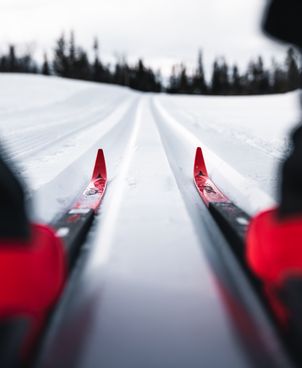
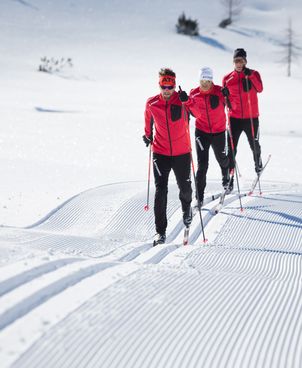
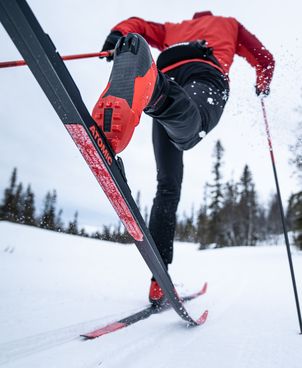
When choosing your ski equipment for cross-country trails, you must first determine what type of skiing you will practice: classic cross-country skiing or skating cross-country skiing.
For classic cross-country skiing (alternate stride), a model 20 to 30 cm longer than the skier's height is suitable. For skating cross-country skiing (skater's stride), you will get better maneuverability and more control with a ski that is 10 to 15 cm longer than your height.
Also refer to the manufacturer's recommendations for choosing your cross-country ski: depending on your weight, the ski's camber and ideal size may vary.
Also, do not neglect the height of the poles : the rule for knowing how to choose between different sizes is to multiply your height in centimeters by 0.89 for skating and 0.83 for classic cross-country skiing.
Children's skis: what size to choose?
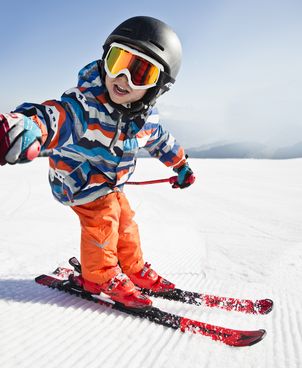
From the age of 2 or 3, children can start learning to ski. Choosing the right children's skis will provide them with the best conditions to feel comfortable, progress, and perform well.
For beginner children aged 3 to 6, relatively small skis are needed, reaching chest height. This will facilitate turning and learning the snowplow.
When the child is at an intermediate level and is between 7 and 12 years old, a pair of Junior skis that are 5 to 15 cm shorter will be suitable. For more experienced Junior skiers, the ski size can be increased slightly so that the child has more control at high speeds. Do not hesitate to ask for advice in-store or from a ski instructor to find the perfect size based on your child's age, level, and weight.
Need more advice on equipping yourself for winter sports? Discover our guides to choose a snowboard, find the right ski boots and a multitude of other tips for your ski equipment and your accessories!