Knowing the basics for skiing
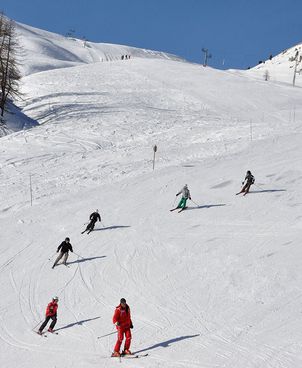
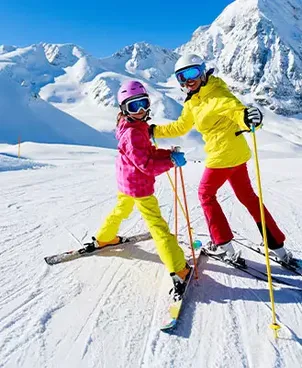
To learn to ski well, you must master a few fundamentals. You need to control your speed, stay alert, ski forward, turn by pressing on the outer ski, know how to get up and negotiate bumps, and master edge control. With time (or even a few ski lessons), you will master these techniques and be able to fully enjoy slopes of all levels. Here are our technical tips and tricks for beginners and skiers looking to progress!
In summary
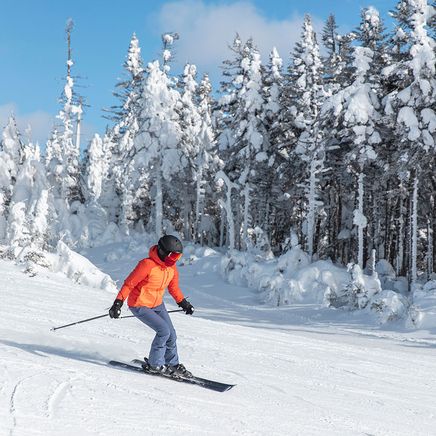
Starting skiing can seem intimidating when you don't know the right moves or essential safety rules. To learn to ski in the best conditions, it is important to master the basics: choosing suitable equipment, adopting the correct posture, learning to turn, brake, and progressing gradually on the slopes. With Sport 2000's advice, you put all the chances on your side to fully enjoy your first descents. Discover the rest of the article to progress with confidence.
The basics of skiing: controlling your speed
Whether you are an adult skier or child, the basis of skiing is tolearn to stop. Either at low or medium speed, using the snowplow technique (press your heels outwards, forming a triangle with your skis), or by skidding (press the edges of your carving skis downhill by positioning yourself perpendicular to the slope, while flexing your knees). Last solution: widen your turns, by lightly pressing on the edges of your skis, then gradually go back up the slope, while letting yourself glide, or by going up "in steps" (making sure, however, not to cut off the trajectory of skiers uphill).
Another basic principle of skiing is to remain constantly attentive to the terrain, but also to the behavior of other skiers for everyone's safety: always look uphill before crossing the slope.
The right position: skiing forward
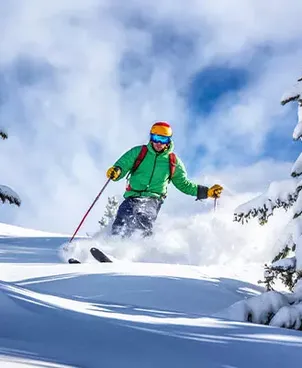
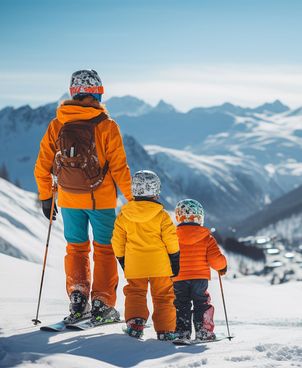
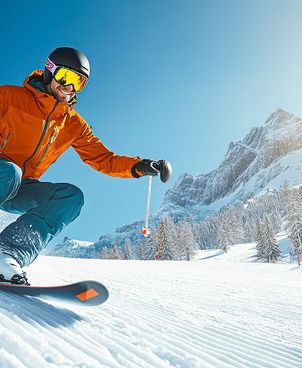
The classic reflex is to ski backward, out of apprehension (which makes you lose balance while increasing your speed...). On the contrary, ski by orienting your body weight forward (your shins should feel the tongue of your boots pressing against them), with your knees bent, like professional skiers in championships at Auron ! This position will offer you better ski control and prevent falls.
Taking a turn: turning by pressing on the outer ski
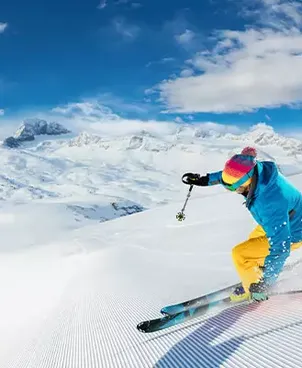
To turn, lean on the outer foot (the one closest to the slope), a fundamental basis of skiing. Specifically, to turn right, press on the left ski, and vice versa. Plant the pole on the right to turn right, and on the left in the opposite case; this will give you more momentum and facilitate your turn. The more you lean your weight on your edges, the greater your turning radius will be (you still need enough speed, otherwise you risk falling if you lean too much).
After a fall: getting up
Beginners, whether junior or adult skiers, can fall quite often (but falling is not excluded for any level of skier!). Nothing dramatic about that, but you need to know how to get back up. To do this, place your skis perpendicular to the slope, then get up by using your uphill pole (the side opposite the slope). If it's a very steep or icy slope, you can also simultaneously use the pole on the slope side to block your downhill ski. As you will have understood, poles are essential not only for making turns, for moving on flat terrain and soft snow, but also for getting back up.
Check that you are not hurt after your fall and pick up any fallen items. Before starting again, your boots must be properly engaged in your skis, and the buckles correctly fastened. If your check takes longer than expected and you have fallen in the middle of the slope, move to one side of the slope and take the time to remove snow from your boots and clothes (hat, gloves...). Finally, adjust your helmet if necessary.
Technical section: negotiating a mogul section
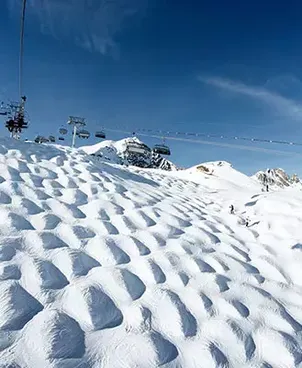
One of the basics of skiing if you want to turn on a mogul is to lean forward, with your knees well bent to absorb the impact when reaching the top of the mogul. Once at the top of the mogul (your tips and tails no longer touching it), pivot and ski down the mogul by skidding.
If you want to jump on a mogul, bend your legs. Just before reaching the top of the mogul, quickly extend your legs, to lift yourself as high as possible in the air, while tightening your gluteal muscles to cushion the landing. The skis must be as parallel as possible to the slope and your legs flexible, to ensure your landing, as you can see in the mogul skiing events at Megève.
Turns and speed: mastering edge control
Using edges is one of the important basics of skiing, as it impacts both the amplitude of turns and speed (slalom competitions in Val d'Isère illustrate this perfectly), so it is very interesting to know how to master them.
On very flat terrain, and in order not to lose speed (otherwise you would have to use your poles or the skater's stride technique), it is better to avoid using the edges, so as not to slow down your momentum.
A minimal edge engagement will allow you to skid and brake. Strong edge engagement will make the ski change direction without reducing your speed, making you take the turn at a greater or lesser angle.
Extra tip: the importance of ski equipment
Equipment plays an important role when learning the basics of alpine skiing or other winter sports. Beginner skis are lighter, more maneuverable, and more forgiving of errors. Obviously, they don't work miracles, but they make it easier for beginners to practice.
However, you need to know how to choose the right equipment... For this, visit the Sport 2000 ski rental website. You will find categories adapted to each skier's level, in the alpine ski category: "blue" ski model or Primo pack for beginners, "red" ski model for skiers with an intermediate level, junior skis, etc. Each pair of skis is rented with poles, and you can, of course, rent boots at the same time.
Once in store, the team will be able to offer you the product that suits you best and adjust the bindings to ensure your safety and comfort.
Then, it's your turn: skiing cannot be learned from books, so head to the green and blue slopes for your first descents or meet with a ski instructor who will teach you the correct body and foot position, the right movement, safety instructions, personalized advice, etc.

FAQ
Frequently Asked Questions
-
How to learn skiing when you're a beginner?
To learn skiing, start on a green slope with equipment suited to your level. Take time to learn the basic posture, braking, and first turns before tackling more difficult slopes.
-
What equipment to choose to start skiing?
A beginner needs easy-to-handle skis, comfortable boots, suitable poles, and a helmet. Renting your equipment at Sport 2000 allows you to benefit from gear perfectly adapted to your level.
-
What are the basics to know before skiing?
Before your first descents, it is essential to know how to put on your skis, maintain a good position, control your speed with the snowplow, and respect safety rules on the slopes.