All about carving in skiing
Before becoming an outstanding skier, you need to know how to adopt the correct body and foot position, distribute your weight well, understand speed, and gradually learn braking and turning techniques. Among the essential techniques, there is carving : discover this movement that will take you to the next level and all our advice for getting started and choosing the right equipment.
In summary
Carving is a skiing technique that allows for more precise, fluid, and dynamic turns, but it requires a good mastery of the basics. Understanding the role of edges, body position, and proper support is essential for effective progress. Sport 2000 explains the principles of carving skiing and tips for improving your technique on the slopes. Discover the rest of the article to learn how to master this gliding method.
What is carving?
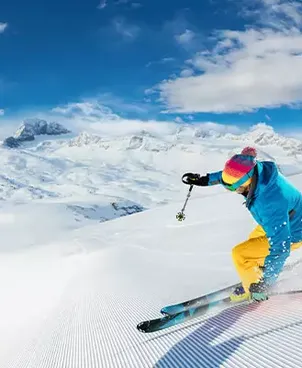
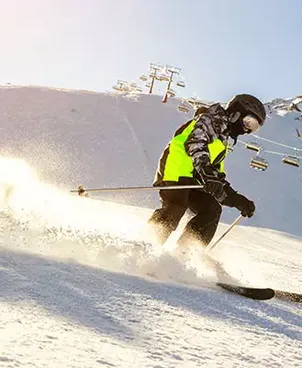
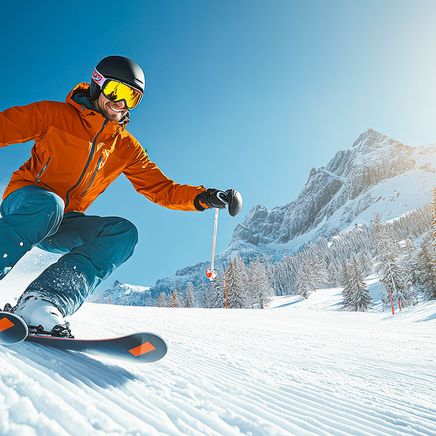
If you've ever watched high-level ski competitions, then you already know what carving is! It's a on-piste skiing technique that consists of making so-called "cut" turns, i.e., turning by positioning the ski on its edge, which digs into the snow. You then need to find the ideal angle to benefit from optimal glide, without leaning too far inward so as not to lose grip.
Skiing by carving therefore differs from skidding, parallel turning, or simple gliding techniques. It allows you to maintain good speed in turns, be more precise, and control your skis well.
Who is carving mastery for?
Carving is a method suitable for skiers who already have a confirmed or expert level. The idea is generally to perfect one's technical mastery, but also to enjoy the slopes even more. Carving is suitable for those who are already comfortable on blue and red runs, capable of descending fluidly in parallel turns, and who wish to fully exploit the power and maneuverability of their skis.
In summary, carving offers the following advantages:
better control and more precision, by drawing precise turns even at high speed;
tenfold pleasure and thrills, with a sensation of fluid and dynamic glide ;
reduction of fatigue, because carving requires less effort than the skidding technique when mastered well;
performance improvement, because carving helps to better understand how one's skis work and allows to minimize speed loss in turns.
How to learn to carve with your skis?
To learn carving, it may be relevant to take a few hours of lessons with a ski instructor. This allows you to learn all the right moves without developing bad habits, and to take it step by step, according to your current level.
CARVING LEARNING STEP-BY-STEP
If you want to learn alone, that's also possible. Here are some tips we can give you to get started with carving:
Start by getting comfortable with edge grip on one foot. Stand facing the slope, skis parallel and flat. To make the carving turn, push your knee towards the inside of the turn, with knees bent, upper body straight and slightly turned forward, weight distributed over the middle of the ski and shoulders facing the slope.
Practice this exercise on one side then the other. When you start to master carving on one foot on a gentle slope, you can then continue to practice on steeper slopes and by gaining more speed.
To perfect the movement, you will then accompany the turn with the outer foot and leg (downhill), and use poles to maintain good balance.
Finally, be patient! Carving is not mastered in a day and you will be able to improve little by little by playing with support, body position, etc.
Don't hesitate to watch carving videos online to better understand each movement and correctly position each part of your body uphill and downhill (feet, knees, pelvis, shoulders, etc.).
ADAPTED CONDITIONS TO INITIATE CARVING IN SKIING
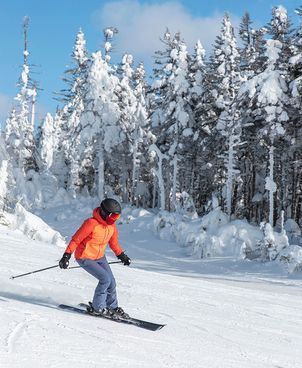
When starting carving, it's better to opt for gentle slopes, for example on a blue run. Afterwards, you can enjoy steeper slopes. The ideal is to choose wide and well-groomed slopes, which offer enough space for wide and dynamic turns. All ski resorts therefore have suitable terrain for carving (although it is still preferable to choose less crowded slopes to feel comfortable, especially at the beginning).
The type of snow also affects the ease of carving. It's better to practice carving on well-groomed and rather firm snow, without it being icy. On soft snow or powder, it will be more difficult to be effective and truly enjoy it.
What type of ski to choose for carving?
While in theory, carving can be practiced with any ski, the ideal is to opt for parabolic skis. These are in fact modern skis, which constitute the majority of current offerings, including with Sport 2000 ski rental. The range consists of parabolic alpine skis that will be suitable for carving, particularly in the categories "confirmed skier" (black skis) and "expert skier" (Diamond skis and Premium skis).
You must obviously choose a "piste-oriented" ski (alpine ski), without necessarily looking for a model designed for competition. For those starting out in carving, having short skis with a short radius will offer better control and facilitate edge grip. It is advisable to start with a ski whose radius is less than 15 meters and whose length is 15 to 20 cm shorter than your height.
If you are already introduced to carving and want to pick up a little more speed, consider a slightly longer ski with a higher radius. This will offer you greater stability at high speed.

FAQ
Frequently asked questions
-
What is carving in skiing?
Carving is a technique that involves using the edges of the skis to make precise turns without skidding.
-
What level is required to practice carving?
It is preferable to master parallel turns before starting to work on this technique.
-
Which skis to choose for carving?
Skis with good grip and suited to your level allow you to better exploit the carving technique.