The different ESF ski levels: a guide to progress
True benchmarks for knowing one's ski level and for progressing, the ESF tests allow acquired skills to be validated and areas for improvement to be determined. These levels are divided into 3 categories according to age: for Piou-Piou from 3 to 5 years old, for children from 4, 5 or 6 years old depending on the level (and up to 12 years old) and for teenagers and adults. Discover in more detail the different levels, the skills and the points of improvement associated with them, to accompany your child in their learning of skiing or to progress yourself!
In summary
It's not always easy to know what ski level you are before booking lessons or choosing your equipment. ESF levels allow you to assess your progress, from beginner to experienced skier, in order to ski on adapted slopes. Sport 2000 explains the different stages of learning and their objectives. Read the rest of the article to better situate your level and progress serenely.
The 3 levels of the Piou-Piou club
From the age of 3, ESF welcomes children to the mountains in its Piou-Piou club, often located at the snow front of the resort. The objective is to introduce the youngest to skiing, helping them to develop their autonomy and motor skills.
Piou-Piou lessons are designed to perfectly adapt to their young age, in a fun discovery setting. But you can still validate your first levels when you are 5 years old or younger!
THE BLANCHOT LEVEL
The Blanchot rabbit is the first step for children learning to ski. It rewards young skiers who are able to move on flat terrain and to slide straight down the slope.
THE SIFFLOTE LEVEL
The Sifflote marmot is awarded to children who can use the ski lifts (magic carpet initially) and who manage to control their speed downhill with the snowplough.
THE GAROLOU LEVEL
The Garolou wolf is the highest level in Piou-Piou. It is validated when the child knows how to put on and take off their skis by themselves and can make snowplough turns.
The 5 levels for children after the Piou-Piou club
Once a child has validated the 3 previous ESF levels, they can take the children's tests. These are based on very precise criteria around autonomy, speed control, turning, precision, etc.
OURSON (BEAR CUB): THE FIRST STEP TOWARDS AUTONOMY
The Ourson level guarantees that the child can ski independently on easy slopes (green runs), as they can then use ski lifts, make snake turns, ski in parallel, etc. At this level and age, the child must, of course, remain accompanied by an adult nearby.
To help your Ourson child progress, your role is mainly to help them build self-confidence and take them to varied terrains, while remaining on green slopes.
FLOCON (FLAKE): THE PATH TO MASTERING THE BASICS OF SKIING
The Flocon medalis the reward for children who manage the basics of skiing, namely speed control, braking,stopping, and parallel skiing.
At this level, the child can link snowplough turns and controls their balance on skis. This is also where they must begin to learn skidding, as it is a crucial step to move to the next level.
THE ESF STARS
To obtain the first star, the child must work on their balance, in order to be able to descend slightly steeper slopes. They must know how to descend both in a straight line and with skidded turns, but also to ski on the slopes while paying attention to other skiers and the surrounding environment.
As a parent, you can accompany them in their quest for the first star by training them in skidding, reminding them of the safety rules on the slopes, and setting an example.
The 22nd Star marks another step inlearning to ski and allows the child to ski on varied terrains, more or less steep and slightly uneven. Bumps, dips, descending across the slope, linking turns and good skids, but also skate steps to move on flat terrain: these are the techniques that must be acquired.
To practice, you must therefore explore different reliefs and work on mastering turns.
As for the 33rd Star, it is obtained when the young skier masters tight turns, has perfect balance , and can brake even at high speed.
Then come the bronze, silver, and gold stars, which indicate a very good level of skiing. The child knows how to ski on all types of snow and terrain, gains precision, masters wedel, and can aspire to participate in competitions with a ski club.
ESF levels for teenagers and adults
You can learn to ski at any age, provided you are well accompanied. Whether in individual lessons or group lessons, the ESF instructor is there to help you understand how to ski well, master the basics to descend your first slopes, and then gain technicality to have maximum fun and explore all terrains.
BEGINNER LEVEL: TAKING YOUR FIRST STEPS ON SKIS
If you have never skied, it is highly recommended to take a few lessons with an instructor. This will allow you to acquire the basics without picking up bad habits and by limiting the risk of injury.
To acquire the first adult level, you must be able to descend slopes with little elevation gain (green runs), master the snowplough technique to brake and make turns, control your speed, but also know how to use all types of ski lift with ease and in complete safety for yourself and other users.
In addition to lessons with a guide, you can practice by following Sport 2000 tips: knowing the basics for skiing, descending with parallel skis, braking on skis, etc. The important thing is to go step by step, not to overestimate your skills, and to keep in mind the tips you learned with the instructor.
ESF CLASS 1
The next step to gain ease and speed on your skis is Class 1.
It is obtained when you know how to descend with simple turns on green and blue slopes, make skids, perform a direct trace, and move with the turning step and the skate step.
ESF CLASS 2
With the Class 2 level, you can really start to enjoy a large part of the ski area.
For this, you must progress from simple turns to parallel ski turns, begin to learn wedel, master simple skids and successions of skids, and trying out various types of snow and terrain.
ESF CLASS 3
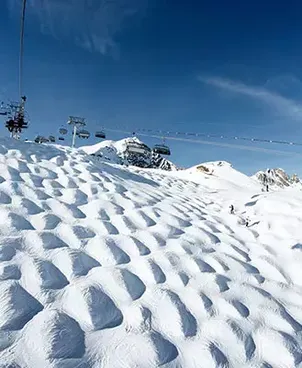
Class 3 is the continuation of class 2: all techniques are perfected and you should feel comfortable on any type of snow, in moguls, on steep terrain, etc.
To achieve this, you will need to work on the precision of your movements and your synchronization. Outside of classes, don't hesitate to film yourself during your exercises to clearly identify small errors and areas for improvement.
ESF CLASS 4
This is the ultimate level before taking performance and competition tests. Skiers who have obtained class 4 have an expert level. They master all techniques and can ski on groomed slopes, icy snow, freshly fallen snow, etc. with perfect ease.
By holding class 4, you can also discover other ski disciplines, such as slalom, freeride skiing, and freestyle skiing, and thus enjoy all that the mountain has to offer in winter!
Additional events for competition
If you wish to improve even further or participate in competitions, other events are offered by the ESF and are aimed at skiers who already have a good or very good level.
These include:
slalom events (Flèche, Chamois, Fusée), to be completed in a defined time;
thetimed kilometer event (timed descent);
theskicross course event, with 4 level variations depending on the time achieved (Gold, Vermeil, Silver, and Bronze), compared to that of the opening instructor;
thelong jump event, also with a Gold, Vermeil, Silver, or Bronze certification, depending on the length of your jump compared to the jump performed by an ESF opening instructor.
Progress through schools
Are you a beginner or would you like to perfect your technique? Among other things, you can count on the Ski Schools which are there to guide you and help you progress.
There is a main one: theFrench Ski School (ESF). It has 250 schools and 17,000 male and female instructors. It offers private and group lessons in alpine skiing, Nordic skiing, snowboarding, freeride, adaptive skiing, telemark, and snowshoeing. There is also the Club Piou-Piou, intended for children from 3 years old, to teach them the first notions of safety and how to move on skis.
You will also find other independent structures bringing together state-certified instructors who can offer you specialized teaching practices (ESI, Evolution 2 …).

FAQ
Frequently asked questions
-
What are the ESF ski levels?
ESF levels range from beginner to competition classes, with several intermediate progression stages.
-
How to know your ski level?
Your comfort on the slopes, mastered techniques, and ESF tests allow you to assess your level.
-
Why are ESF levels important?
They allow you to choose suitable lessons and progress at your own pace safely.