Alpine skiing: origin and evolution
Whether you are a beginner skier or an experienced skier, you may not know the fascinating history of alpine skiing. In addition to helping you choose your ski equipment, Sport 2000 also allows you to broaden your general knowledge by tracing its history, from the beginnings of this practice to the form in which we know alpine skiing today. Note that its origin is debated, and several countries or regions claim paternity. Modern alpine skiing appeared at the end of the 19th century and gained increasing interest with the first events at the Olympic Games and World Championships. This discipline has known its golden age since the 1960s, a success also explained by theconstant evolution of equipment, which skiers of all ages and levels benefit from today.
In summary
Alpine skiing is today one of the most popular winter sports, but do you really know its history? From its origins to the evolutions of equipment and techniques, alpine skiing has constantly transformed to become more accessible and performing. Sport 2000 helps you discover the major stages of this evolution as well as the specificities of this essential discipline. Read on to better understand the world of alpine skiing.
What is alpine skiing: definition and history
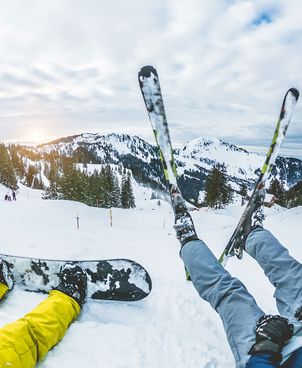
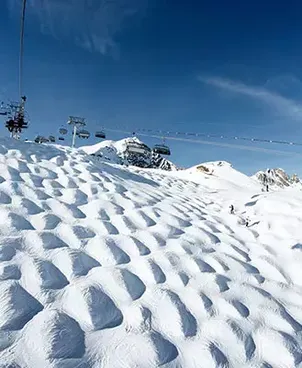
This discipline encompasses all downhill and slalom ski sports activities on slopes. Thus, in competition form, it can be a slalom, giant slalom, super giant slalom (or super-G), downhill (including on a mogul field) or alpine combined event.
But what is alpine skiing originally? Its exact period of appearance is not clearly established, and several countries claim to be the origin of the winter sport. Some people believe it originated in Central Asia, in the Altai mountain range, in Russia. Others lean towards Mongolian or Chinese roots (the first skis in history were found in China).
Its function, however, is beyond doubt: it was primarily about moving faster by gliding on snow.
Finally, some believe that it was invented a long time ago in Scandinavia (as the famous painting "Birkebeiner" by Knud Larsen Bergslien suggests), more precisely in Norway, and this irrefutably from the 18th century. Discovering what competitive alpine skiing is certainly leads to establishing an undeniable lineage with Norway: in 1870, in Oslo (then called Christiania), the first cross-country and jumping events took place, and the first Norwegian ski competitions appeared in 1892, in Holmenkollen (which hosted the events of the 1952 Winter Olympics).
In France, it was in 1879, in Chamrousse, that Henri Duhamel discovered this sport and popularized its use. Skiing was also used by soldiers after 1900 to monitor the French-Italian border, and more particularly in the area of the fortified city of Briançon.
The general public discovered what alpine skiing was during the first international sports competition, which took place in France in 1907, in Montgenèvre. The first official downhill event took place in Montana (Switzerland) in 1911, then the first slalom in 1922, in Mürren (Switzerland).
Skiing (Nordic) made its appearance at the first Winter Olympics, which took place in the heart of the French mountains, in Chamonix in 1924. But it was in 1931, at the World Championships, and then in 1936, at the Olympic Games, that alpine skiing events were recognized as official disciplines, notably thanks to the work of the Briton Arnold Lunn, who was one of the first to discover what alpine skiing was.
In France, alpine skiing first gained some popularity under the leadership of Émile Allais, three-time world champion in Chamonix in 1937, co-creator of the French ski school (1937), inventor of parallel skiing, and notorious pioneer of ski equipment, such as stirrup pants. From the 1960s onwards, between the development of snow plans aimed at creating or developing modern ski resorts (as perfectly illustrated by La Plagne and Les 2 Alpes) and the exploits of French champions such as Jean-Claude Killy or Marielle Goitschel, alpine skiing experienced significant enthusiasm and paved the way for other winter sports.
Since then, great names have shown what alpine skiing pushed to its paroxysm truly is, and have contributed to its current popularity in Europe, but also all over the world: Alberto Tomba, Herman Maier, Lindsey Vonn, Alexis Pinturault, and Marcel Hirscher.
Evolution of alpine ski equipment
The first alpine skis were made of wood, covered with horsehide, and measured 2 meters.
Alpine skiing then split into 2 schools invented in Norway: Christiania (classic alpine skiing) and Telemark (where each turn requires a flexion of the legs).
The first industrial wooden skis were invented in France in 1893.
In 1928, wooden skis were equipped with metal edges.
In 1950, aluminum alpine skis made their appearance.
In 1993, many wondered what classic alpine skiing still had to do with the latest (r)evolution of this equipment: parabolic skis, skis with thin waists, and wider tails and tips.
In the 2000s, the size and shape of alpine skis continued to evolve, for example with the rocker (tip rise), to improve ski flotation in powder, on ungroomed snow, or at the edge of the slope.
Offering ever more technique, speed, and comfort, carving skis are now sophisticated equipment, and are available in a wide variety of models to suit all skier profiles.
So, if during your mountain vacation, you hesitate between one range and another, do not hesitate to ask for advice from the Sport 2000 team at your ski rentalshop. The salespeople there will offer you a wide choice of alpine ski rental equipment adapted to your needs.
Furthermore, don't forget that our shops present in most French resorts (Alps, Pyrenees, Jura, Vosges, Massif Central, etc.) also offer rental equipment for disciplines other than piste skiing. For example, rent cross-country skis, freestyle skis, a snowboard, etc.

FAQ
Frequently asked questions
-
What is alpine skiing?
Alpine skiing is a discipline that involves descending snowy slopes equipped with ski lifts.
-
What is the origin of alpine skiing?
Skiing originated in the Nordic countries before developing in the Alps at the beginning of the 20th century.
-
Why has alpine ski equipment evolved?
Innovations have improved skiers' safety, comfort, and performance.