Ski maintenance: Sport 2000 tips and services
Well-maintained skis are the guarantee of optimal performance and equipment that lasts longer. But what exactly does maintenance consist of? What should be done and how often? Can you maintain your skis yourself or is it better to entrust your equipment to a professional ? Here is a guide to answer all these questions, so that your pair of skis or your snowboard is maintained as it should be!

In summary
Well- maintained skis are essential for safe skiing and optimal performance on the slopes. Good ski maintenance helps preserve gliding quality, improve grip, and extend the life of your ski equipment. Thanks to the advice and services offered by Sport 2000, discover the key steps of maintenance, from waxing to edge sharpening, as well as best practices to keep your skis in perfect condition throughout the season. Read on to learn all about it.
Maintaining your skis: why is it essential?
If you've bought your own skis, you know it's a small investment and you have every interest in taking care of them. And that goes well beyond the aesthetic aspect of the ski, because appropriate maintenance allows you to:
maintain the optimal performance of your equipment, with skis that glide better, edges that grip better, smoother handling, less friction that reduces speed, etc.
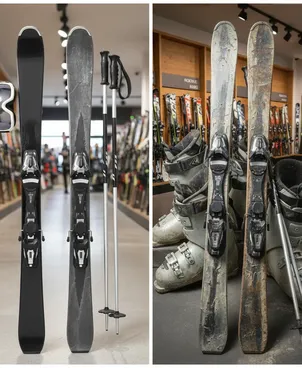
prolong the lifespan of the equipment : regular maintenance protects skis against premature wear (e.g.: waxing prevents the base from drying out, repairing impacts prevents progressive degradation of the ski);
optimize enjoyment on the slopes : well-maintained skis allow you to glide smoothly, turn easily, feel reassuring stability, and thus experience the best possible time on the slopes;
guarantee your safety : poorly sharpened edges or a damaged base increase the risk of falls, particularly on difficult terrain and icy snow.
What are the main steps in ski and snowboard maintenance?
Ski and snowboard maintenance requires several operations: we explain how it works step by step.
Ski waxing
Waxing consists of applying a special wax to optimize glide by reducing friction with the snow and to protect the base from humidity and temperature variations.
To wax skis, you need a waxing iron, a wax adapted to the type of snow, a scraper to remove excess wax, as well as a cloth and a brush to clean and polish the base. Before waxing, it is important to thoroughly clean the ski and remove the existing wax layer. The wax is then applied evenly over the entire base with the iron set to the correct temperature.
It is recommended to wax your skis before the start of the season to prepare the equipment and at the end to protect it during storage. During the season, waxing every 3 to 5 outings is recommended for regular skiers.
Ski sharpening
Sharpening consists of working the edges of the skis to ensure optimal grip on the snow. This allows for better control of turns, even more so on hard or icy snow, and avoids the risk of uncontrolled skidding.
To sharpen skis or a snowboard, you need a file, a blade angle guide, a sharpening stone, and a brush. After setting the sharpening angle, you must run the file over the edge, then remember to remove the filings and go over it with the stone for finishing.
The sharpening operation should be performed when you feel that your skis are skidding too much or that there are irregularities on the edges. It is advisable to sharpen the equipment at the beginning of each season and whenever the edges have been subjected to significant impacts.
Repair of cracks and impacts
Ski bases are often put to the test and can suffer damage that requires repair. An impact or a crack does not necessarily mean that the skis are unusable, but they must be taken care of.
For superficial scratches, you can simply use a repair stick, which you heat to apply and fill the scratches. If the damage is more significant, you will need to proceed with overmolding (overmolding is an operation that consists of filling the hole or crack with a specific material).
Equipment storage
Once ski maintenance is complete, the importance of storage should not be overlooked. It is preferable to store vertically, to preserve the shape of the skis. Nevertheless, horizontal storage remains possible, as long as the skis are not directly on the ground and no objects are placed on them (there are specific racks for storing your skis, which even allow for space saving if you place them at height).
Remember to raise and loosen the bindings of the skis and close the binding buckles for a snowboard. This will preserve the shape of the bindings until your next outing.
Also, make sure that the skis, like ski boots, are stored in a dry, humidity-free, and ventilated place. This will prevent rust from forming on the edges and bacteria and mold from proliferating in the boots. Of course, you must completely dry your equipment before storing it to await the next winter sports season.
Having your skis maintained: what are the prices?
Entrusting the maintenance of your skis to a professional is often a practical and effective solution. Prices vary according to the desired services (waxing, sharpening, repair, etc.), their complexity , and the store's pricing policy .
For example, a simple wax can cost around 7 to 10 euros, while a complete service including sharpening, waxing, and minor repairs is offered for around 30-40 euros. Some stores also offer seasonal packages for regular maintenance at a preferential rate.
In-store ski workshop: benefit from Sport 2000's expertise for ski maintenance
While it is entirely possible to acquire ski waxing, sharpening, and repair equipment and perform the maintenance yourself, it is still safer and more practical to entrust these operations to a ski professional.
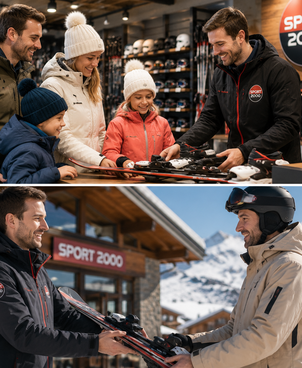
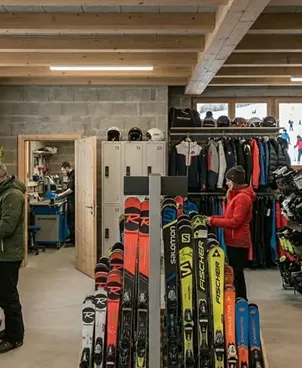
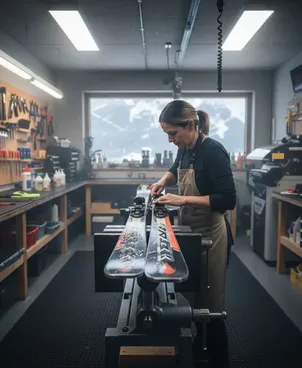
All Sport 2000 ski rental stores have a ski workshop where ski technicians take care of your alpine skis, freestyle skis, touring skis, snowboards, etc. By choosing this option, the advantages are:
professional equipment : Sport 2000 stores have specialized equipment and products that ensure adapted, precise, and durable maintenance; technical expertise
: workshop technicians have solid experience in ski and snowboard maintenance and can quickly diagnose needs and offer adapted advice and solutions; time saving : in-store maintenance saves you tedious handling, and often time-consuming when you are not used to performing maintenance. You can sometimes drop off your skis at the store and pick them up within the hour or the next day;
accessible prices
and affordable prices : in-store ski maintenance services are inexpensive, costing you from a few euros to a few tens of euros depending on the operations performed. Unless you ski every winter and wax your skis every week or want perfectly sharpened edges every outing, it is therefore more cost-effective to go through a professional, especially since the result will be long-lasting.
In short, by entrusting your skis to Sport 2000, you benefit from a professional service that maximizes your pleasure on the slopes and the longevity of your equipment!

FAQ
-
How to properly maintain your skis to improve their performance?
Good ski maintenance consists of regularly waxing the base, sharpening the edges, and repairing any scratches. These operations improve glide, strengthen grip on the snow, and extend the life of your ski equipment. Regular maintenance also allows you to ski in better safety conditions.
-
How often should you maintain your skis?
It is recommended to perform ski maintenance every 5 to 10 days of skiing, depending on your level of practice and snow conditions. Regular waxing and edge inspection ensure high-performance skis throughout the season and limit premature wear of the equipment.
-
What ski maintenance services does Sport 2000 offer?
Sport 2000 offers completeski maintenanceservices, including waxing, edge sharpening, base repair, and equipment preparation before or after the season. Entrusting your skis to professionals allows you to preserve their performance, improve your gliding comfort, and extend their lifespan.