Maintaining your skis: essential tips and products
Do you want to keep your skis performing well and in good condition as long as possible? Good maintenance is therefore necessary, whether you are a fan of alpine skiing, freestyle skiing, off-piste skiing, etc. Sport 2000 provides you with expert advice for carrying out this ski maintenance : the essential steps, the necessary equipment, indispensable tips, etc.

In summary
Poorly maintained skis lose performance, grip and gliding comfort over time. To fully enjoy your equipment and prolong its lifespan, it is essential to adopt the right practices and use suitable products. Sport 2000 explains how to perform ski maintenance effective, from waxing to cleaning, including edge sharpening. Discover in the rest of the article all the tips and essential products to keep your skis in perfect condition throughout the season.
Meticulous ski maintenance: why is it essential?
In contact with snow, moisture, and sometimes even stones or other rough spots on the slopes, your pair of skis or your snowboard wears out little by little. This is a normal phenomenon, but it explains why regular and adapted maintenance is essential.
Indeed, if you don't take care of your equipment, the risks are multiple: skis that rust, appearance of small or large grooves, or even holes, etc. And all of this affects not only the quality of performance, but also your safety. With worn or damaged skis, the risk of loss of control and fall is indeed much higher.
In addition, regular maintenance extends the lifespan of your equipment, and it will always cost you less to maintain your skis (or entrust them to a pro workshop) than to have to frequently buy a new pair.
Waxing: the key step for maintaining your skis
Waxing consists of applying a layer of special wax on the base of the skis, so as to protect it and improve gliding. Discover our tips for well-waxed skis.
When to wax your skis?
It is advisable to wax your ski bases before each start of the season. If you stored your skis with a good layer of wax on them at the end of the previous season, it may, however, be sufficient to scrape off the excess with a scraper specific.
During the season, it is then recommended to wax your skis every 4 to 6 outings, in order to maintain good gliding properties and avoid premature wear. If you ski in competition, or if you notice traces of abrasion, this frequency can even be daily.
Can you wax your skis yourself?
Ski waxing is not a very complex operation, especially if you opt for cold waxing. In liquid form, the wax is easily applied to the base with a cloth, then brushed after a few minutes of drying. This is the easiest and most practical solution for waxing yourself.
Nevertheless, the performance and effectiveness duration of liquid wax are lower compared to hot waxing.
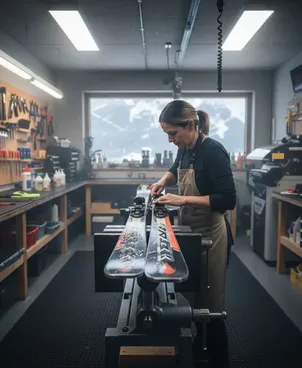
The hot waxing is therefore the most used technique in ski workshops: you can entrust your pair of skis to a Sport 2000 store for this maintenance. If, however, you want to do it at home, you will need to purchase a waxing kit consisting of a few essential accessories:
wax, available in different models and to be chosen according to temperatures and snow type (hard snow, cold and compact snow, more or less wet snow, soft spring snow);
waxing iron, to spread the wax and make it penetrate the base, making sure to set the iron to the correct temperature;
brush and scraper, to remove excess wax.
Edge sharpening: the other important point for high-performance and safe gliding
The other step required to maintain your skis is to sharpen the edges, i.e., the metal edges that allow you to bite into the snow and grip well.
When to sharpen your skis?
Edge sharpening guarantees stability in turns and ski control. It is therefore recommended to perform this operation as soon as you feel a poorer grip on hard or icy snow, or if you visually notice that the ski edge is worn out.
Nevertheless, too frequent sharpening will undeniably wear out the edges: that's why it is generally advised to sharpen your skis or snowboard 1 to 2 times per season.
Can you sharpen them yourself?
Sharpening is a slightly more technical operation than waxing, and incorrect movements could irreversibly damage your equipment. You must be careful not to remove too much material, while respecting a certain sharpening angle.
However, it is not impossible to perform this maintenance yourself. You will then need to invest in several accessories:
an Edgerazor, to strip the ski edge beforehand;
a blade angle guide ;
some diamond sharpening stones ;
a file ;
a brush.
Winterization tips to preserve your equipment
Maintaining your equipment also involves optimal storage conditions when you are not on mountain holidays, or at the end of winter.
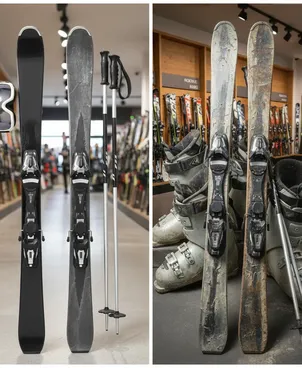
It is essential to remove dust and other dirt and to dry the skis carefully before storing them in a suitable cover. The ideal is to store your equipment in a dry place, where the temperature is not too high, and to lay the skis flat (on a ski rack for example) or store them vertically with the bases facing each other. Take the same care with your ski boots, drying them completely before storing them.
Also remember to loosen the bindings, so as not to overstress the springs. Of course, you must not forget to properly adjust the bindings again before reusing your skis the following winter.
During your stay, it is also important to follow certain instructions. It is essential to dry the skis well before storing them in a dry place, to prevent rust on the edges and metal parts of the bindings, even if it's only for a night or a day or two.
Remember to check the condition of the skis, if not every day, at least once a week, to ensure there is no serious damage and to perform necessary maintenance in time.
If needed, whether for maintenance operations like waxing or sharpening, for base repair, or for a more extensive repair, you will find qualified professionals in Sport 2000 stores, present in many ski resorts in France.