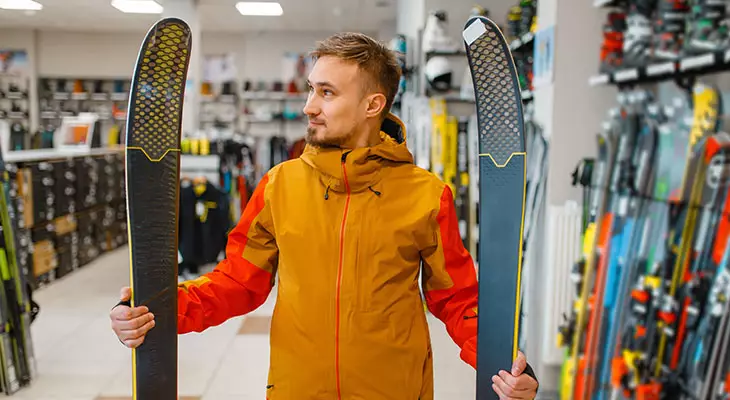
Introduced in the 1990s, parabolic skis (also called shaped skis) now make up the majority of skis available on the market. What’s the difference between parabolic and traditional skis? How do you choose the right ski length according to your skill level and intended use? What other technical criteria should you consider? Sport 2000 shares tips for choosing your ski equipment, specifically for parabolic skis.
Difference between parabolic and traditional skis
In 1993, a new type of alpine ski appeared: the parabolic ski, now the most commonly sold model. You can find these skis in the Sport 2000 rental range for both adults and children.
Parabolic skis are characterized by their shaped profile, with wider tips and tails than the waist (middle part). They are also shorter than traditional skis—typically 10 to 20 cm shorter than the skier’s height.
These features make parabolic skis very responsive and easier to turn. More stable than classic skis, with edges designed to facilitate different turns, they grip the snow better and reduce the risk of falls. In short, parabolic skis are a must-have for modern skiing!
Choosing ski length according to skill level
On-piste parabolic skis are usually narrower and shorter, making it easier for beginners and intermediate skiers to link turns. A beginner should typically use skis about 10 cm shorter than their height, with a wide waist (minimum 85 mm) for stability.
Intermediate skiers usually choose skis 5 cm shorter than their height. There are also progressive skis for intermediates, which are more responsive than beginner skis (designed to minimize mistakes, especially in turns).
Only advanced skiers might use longer skis (5 cm taller than their height) to gain edge grip at high speeds. There are also performance and racing parabolic skis, designed for speed and competitions, like those at Auron, Courchevel, or Val d’Isère.
If you want to ski beyond groomed slopes, different parabolic skis are designed for other uses, with varying lengths.
Choosing parabolic skis according to purpose
For off-piste skiing, you need freeride parabolic skis, 5 to 10 cm longer than your height and wide (waist width 90–120 mm) for better flotation in powder snow.
Conversely, touring skis are 5 to 10 cm shorter, designed to allow both uphill and downhill skiing, offering great freedom of movement.
For freestyle skiing or mogul competitions, for example at Megève or X Games-style skiing at Tignes, you need freestyle skis. These are shorter (around 10 cm) and lighter for greater maneuverability during jumps.
For versatility on both groomed and off-piste terrain, choose all-mountain parabolic skis, slightly wider than regular piste skis (waist width 85–90 mm).
Other technical factors to consider
Beyond length, other elements influence your ski choice, depending on discipline, terrain, snow type, weight, and skill level:
- Flex: The rigidity of the ski. Stiff skis are for advanced, fast skiers. Beginners or powder enthusiasts should choose softer flex for better grip.
- Fat: Refers to ski width. Wider skis provide more stability, e.g., freeride or freestyle skis.
- Rocker: The rise of the tip and tail of parabolic skis, improving flotation.
- Camber: The arch of the ski, usually 3–5 cm, except for freeride skis, which may have reverse camber (only the waist touches the snow).
- Skier’s physique: Small or light skiers benefit from shorter skis for maneuverability; heavier skiers need longer skis for stability.
Don’t forget to carefully choose your ski boots, which are equally essential for a comfortable mountain experience.