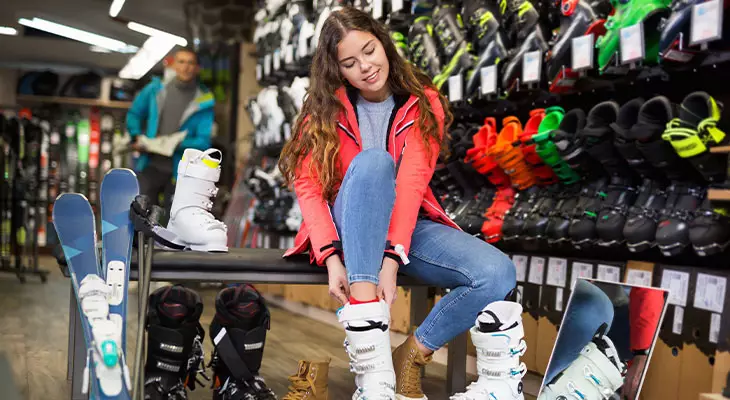
Winter holidays in the mountains are often unforgettable. To make the experience as enjoyable as possible, choosing the right equipment is essential. Be realistic about your skiing level (first-time skier, beginner, advanced, etc.) to get the most suitable gear: ski boots, bindings, skis, poles. Here are our expert tips to make the right choice, whether you’re buying or renting!
Choosing ski equipment: start with the right boots
Ski boots are the cornerstone of any skier’s equipment. They connect you to your ski bindings and significantly influence your skiing technique and precision. Knowing how to choose ski boots will prevent discomfort when skiing at high speeds and during turns.
Key elements to consider include the flex (stiffness index) of the boot, which partly determines how well it supports your foot and tibia. You should be able to touch the tip of the boot when standing upright. Boots that are too large can cause rubbing, pain, blisters, or cramps. Also, always try your boots with the socks you plan to wear on the slopes.
Additionally, consider temperature variations: can your boots handle extreme cold or spring conditions (for example, on glaciers in Tignes or Alpe d’Huez)? Do they have ventilation options?
Choosing ski bindings with the right stiffness
Alpine ski bindings connect your boots to your skis. There are specific bindings for freeride skis (off-piste, mainly powder snow). Bindings are standardized internationally (ISO 11088), ensuring a proper match with boots and skis.
The binding stiffness is critical: you need secure bindings to hold your boots while allowing release in case of a fall, preventing injuries and keeping skis from sliding away with the "ski stop" system. Like helmets and slope safety rules, bindings are an essential safety feature.
The recommended stiffness depends on the ski model, your body type, fitness, and skiing level. Medium stiffness ranges between 6 and 14. Only expert skiers should consider settings above 16. When renting from Sport 2000, the team will adjust your bindings before you hit the slopes.
Choosing skis suited to your level and style
Different ski models suit different uses. All-mountain skis are ideal for both piste and off-piste. Freeride skis, wider and more stable, are suited for off-piste, while freestyle skis, lighter and more agile, are designed for tricks.
Inspired by professional skiers competing in the giant slalom at Val d’Isère? Race or carving skis are designed for competition and are recommended only for highly skilled skiers. These skis are stiffer, longer, and allow high speeds, quick edge changes, and extreme turns. Beginners should stick with classic alpine skis: tolerant and easy to handle.
Choose skis matching your height or up to 10 cm longer (15 cm for very advanced skiers seeking race skis). Also, check the durability of the ski materials.
Ski poles suited to the terrain
Size charts help determine the right ski pole length based on your height and gender. Similar charts exist for skis, bindings, and boots, guiding you in selecting the proper equipment.
For freeride, use longer poles with large baskets to avoid sinking into deep snow. In freestyle, beginners can use standard alpine poles, while advanced skiers often prefer shorter, lighter poles for better maneuverability during tricks.
Some poles have detachable straps, and certain models include guards to protect hands when hitting gates during competition.
For more guidance on your next mountain trip or ski vacation, check our guides on snowboard selection, ski helmet safety, choosing snowshoes for winter hiking, and what to pack in your ski vacation bag.